
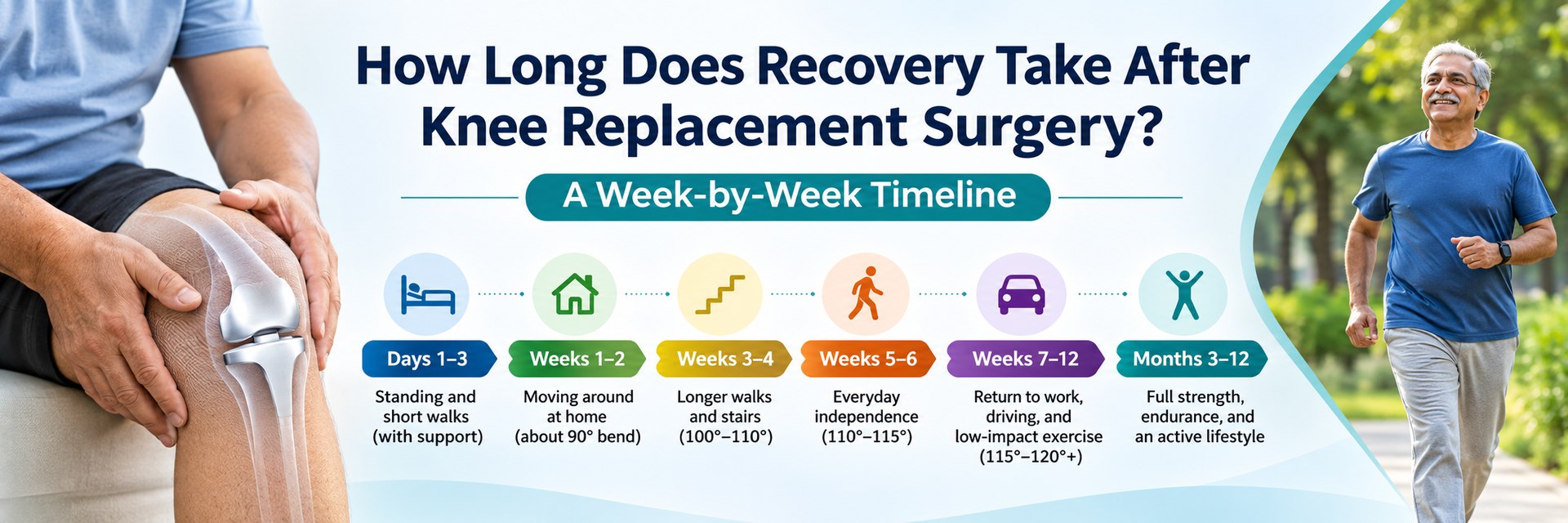
How Long Does Recovery Take After Knee Replacement Surgery? A Week-by-Week Timeline
Deciding to undergo total knee replacement surgery is a major milestone toward reclaiming a pain-free, active life. However, for most patients, the biggest question before entering the operating room is: “How quickly will I be back on my feet?”
While every patient heals at an individual pace depending on age, overall fitness, and pre-surgical joint condition, most people return to everyday routine activities within 6 to 12 weeks, with complete muscle strength and implant adaptation continuing up to 6 to 12 months.
Knee Replacement Recovery at a Glance
Recovery after knee replacement follows a fairly predictable pattern. This table shows what most patients can expect at each stage — from the first supported steps in hospital to a fully active lifestyle:
| Recovery Phase | Key Mobility Milestone | Target Knee Bend | Assistive Device |
|---|---|---|---|
| Days 1–3 (Hospital) | Standing and walking short distances | Full straightening (0°); gentle bend | Walking frame |
| Weeks 1–2 | Navigating home safely; bathroom independence | Up to 90° | Walker |
| Weeks 3–4 | Longer indoor/outdoor walks; practicing stairs | 100°–110° | Walking stick / Cane |
| Weeks 5–6 | Smooth walking gait; light household tasks | 110°–115° | Cane or unassisted |
| Weeks 7–12 | Resuming desk work, driving, and low-impact exercise | 115°–120°+ | Unassisted |
| Months 3–12 | Full endurance, muscle strength, and active lifestyle | Maximum functional range | Unassisted |
Typical milestones. Your surgeon and physiotherapist will set targets for your knee.
Week-by-Week Recovery Roadmap
Days 1 to 3: Taking Your First Steps
Recovery begins almost immediately after surgery. Once anesthesia wears off, your orthopedic care team and inpatient physiotherapists help you stand and take your first supported steps using a walking frame.
- Primary Focus: Pain control, blood clot prevention through ankle pumps, and achieving full knee straightening (extension).
- Hospital Discharge: Most patients are discharged within 2 to 4 days once pain is manageable with oral medication and they can safely walk short distances and use the washroom with support.
Weeks 1 to 2: Settling In at Home
The first two weeks are the most demanding part of recovery, characterized by surgical swelling, stiffness, and interrupted sleep.
- Daily Routine: Walk for 5 to 10 minutes every couple of hours using your walker to keep blood flowing and prevent joint stiffness.
- Rehabilitation Goal: Gently bend your knee toward a 90-degree angle while keeping your surgical dressing clean and dry.
- Crucial Tip: Rest with a pillow under your ankle — never directly beneath your knee — so your joint heals completely straight.
Weeks 3 to 4: Building Confidence and Transitioning Off the Walker
By the third week, acute surgical soreness subsides noticeably, and your energy levels begin to climb.
- Mobility Shift: Many patients transition from a bulky walker to a single walking stick or cane as balance improves.
- Stair Training: Your physiotherapist will teach you safe stair navigation (“up with the good leg, down with the operated leg”).
- Rehabilitation Goal: Reach 100° to 110° of knee flexion and extend outdoor walks to 15–20 minutes twice a day.
Weeks 5 to 6: Returning to Everyday Independence
At the six-week mark, your new knee begins feeling steadier and far less fragile.
- Daily Milestones: You can comfortably perform light household chores, walk longer distances without a limp, and begin low-resistance stationary cycling.
- Driving & Work: Patients with desk jobs often return to work around week 6. If your left knee was operated on and you drive an automatic vehicle, your surgeon may clear you to drive once you are off sedating pain medications.
Weeks 7 to 12: The Strengthening Phase
Once a healthy range of motion is established, physiotherapy shifts from basic flexibility to rebuilding quadriceps, hamstring, and calf strength.
- Active Recovery: Walk 30 to 45 minutes comfortably without walking aids. Most patients who underwent right-knee replacement receive clearance to drive during this window.
- Low-Impact Fitness: Safe, joint-friendly activities such as swimming, water aerobics, and brisk walking — or robotic physiotherapy — help restore stamina without overloading the artificial joint.
Months 3 to 12: Long-Term Strength and Full Recovery
Between three and six months, most people stop thinking about their knee during daily routines. Mild swelling after heavy activity is still completely normal and gradually disappears over the first year as surrounding muscles reach peak strength.
Essential Do’s and Don’ts for a Faster Recovery
Small, consistent habits protect your new joint and speed up recovery:
- DO prioritize physiotherapy: Consistent daily home exercises matter far more than occasional intense workouts.
- DO use ice and elevation: Apply wrapped ice packs for 15–20 minutes after exercises to calm post-workout swelling.
- DON’T twist or pivot sharply: Turn your entire body when changing direction rather than pivoting on your operated knee.
- DON’T rush high-impact activities: Avoid running, jumping, deep squatting, or sitting cross-legged on the floor unless specifically cleared by your orthopedic surgeon.
When to Contact Your Orthopedic Surgeon Immediately
While soreness and mild swelling are expected parts of healing, seek prompt medical evaluation if you notice:
- A fever above 101°F (38.3°C) or chills.
- Spreading redness, foul-smelling drainage, or increasing warmth around the incision.
- Sudden, severe pain, tightness, or swelling in your calf or thigh.
- Chest pain or sudden shortness of breath.
Take the Next Step Toward Pain-Free Movement
Every successful knee replacement pairs precision surgery with structured, personalized rehabilitation. If chronic knee pain limits your daily mobility, consult an experienced joint replacement specialist to evaluate your joint health and map out a tailored treatment and recovery plan.
At MJ Naidu Super Speciality Hospital, Vijayawada, our joint replacement team guides you from pre-surgical assessment through every phase of rehabilitation. If pain at night is your main concern, read about knee pain at night. Book a consultation using the appointment option below.
Table of Contents
Knee pain slowing you down?
Our joint replacement specialists can assess your knee and plan your recovery.
Take the First Step Toward Pain-Free Movement
📍 Location: MJ Naidu Super Speciality Hospital, Vijayawada
📞 Book an Appointment: Call 96401 33302 to schedule your consultation with our joint replacement specialists.
Medical Disclaimer: This blog post is intended for general informational purposes only and does not substitute for professional medical advice, diagnosis, or treatment.